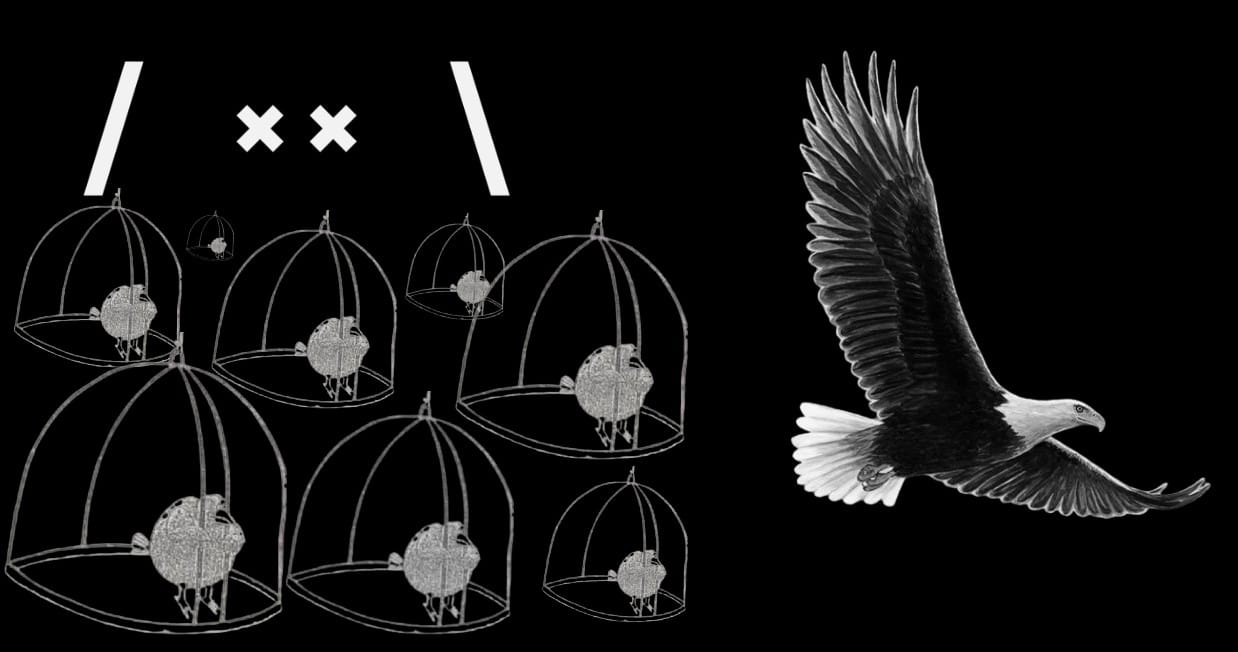
There's a harsh reality in the "vibe coding" era: the AI isn't the slow part. You are.
Not because you're bad at your job. Because you're spending your day managing the AI instead of building anything. You babysit one agent, wait for it to finish, copy-paste context into the next session, repeat. You stopped writing code and became an air traffic controller for a single plane.
That's not leverage. That's a job with extra steps.
Companies are starting to figure this out. They didn't bolt AI onto a chat window and call it a product. They built background agents: autonomous systems that do real work across their codebases without a human hovering over every keystroke. Agents that run in the background, file pull requests, and move on to the next thing. The engineer reviews and merges. The agent never stops.
That's the model. We built Uncaged to bring it to everyone.
Background Agents for the Rest of Us
Large companies have an army of engineers and the infrastructure budget to build custom agent tooling in-house. You might not. Uncaged gives you the same architecture without the headcount: background AI agents building in parallel across fully isolated cloud workspaces, connected directly to your repos, running whether you're watching or not.
Each workspace is a real environment. Not a sandbox. Not a notebook. Not a chat window cosplaying as a filesystem. You get a full Linux server with SSH access, Docker support, Git, Node, Python, Rust, Go, and an AI coding agent wired into your codebase the moment it spins up.
Connect a GitHub repo. Pick a branch. Choose a model. The workspace clones your code, detects your stack, installs dependencies, and the agent gets to work. You can talk to it through chat, or just assign it a task and walk away. It responds with code: commits, branches, pull requests.
Then you open another workspace. And another. Different repos, different features, different projects, all running in the background at the same time. Isolated from each other. Own agent, own terminal, own git state. You check in when you want, not because you have to.
Uncaged isn’t replacing you. Uncaged is giving you the same background agent setup that billion-dollar engineering orgs are using internally, except you don't need to build or maintain any of it.
Every Model, No Lock-In
Uncaged doesn’t gate you to one provider. Uncaged ships with built-in access to the models that actually matter right now:
- Codex 5.3 and GPT-5.2 from OpenAI
- Claude Opus 4.6 and Sonnet 4.5 from Anthropic
- K2.5 and GLM-5 from the open frontier
New models get added as the frontier moves. Every workspace has a model picker, so you can swap mid-conversation if something isn't clicking. A gnarly refactor might call for Opus. Quick bug fix, Sonnet. Research-heavy exploration, maybe Codex. You pick per workspace, per session, whatever fits the job.
Bring your own API keys if you already pay for Anthropic or OpenAI, or connect your ChatGPT Pro accounts. Your keys, your tokens, your spend.
One more thing: Uncaged is self-improving. We use the platform's own agent system to develop the platform. Every feature we ship gets built in an Uncaged workspace. We're our own power users, and the feedback loop is tight.
Not a Wrapper. An Actual Machine.
Most "AI coding" tools gloss over what's underneath and skimp on the specs. Uncaged doesn’t. Every Uncaged workspace is a legitimate cloud dev environment, and we want to be specific about what that means.
- Full SSH access: Connect from your local terminal or VS Code Remote. Real machine, real shell. Run whatever you want.
- Docker-in-Docker: Run Postgres for integration tests, docker compose up your service dependencies. Works as expected.
- Persistent volumes: Stop a workspace Friday, come back Monday. Everything's where you left it.
- Configurable resources: Preset instance sizes or advanced mode: 1–32 vCPUs, 1–32 GB RAM, up to 1 TB storage. GPU instances for ML work.
- Git workflow baked in: View diffs, push branches, open PRs, merge from the UI—or SSH in and use your own tools.
- Task boards that agents actually use: Create tasks, assign to workspaces. The agent picks up work, posts progress as comments, pushes a branch, and moves the card to review.
Teams Without the Overhead
This isn't just a solo developer tool. Orgs work out of the box:
- Create a team, invite people by email, set roles
- Everyone sees each other's workspaces and what agents are doing
- Billing scopes to the org, so the company pays
- Workspaces inherit the org context automatically
Picture your whole engineering team running parallel agents against the same monorepo. Each person juggling a handful of workspaces across different features. The throughput math gets silly fast.
More Ways to Uncage Your Workflow
The product today is solid. But the background agent model unlocks a lot more when you push it further.
- Slack as a control plane: Talk to agents from Slack. Get pinged when a PR lands. Spawn a workspace directly from a thread. Agents live where your team already talks.
- Spawn workspaces with a slash command: /uncaged start my-repo fix-auth-bug and walk away. No UI. One command, one agent, one workspace.
- Scheduled product research: Set up recurring agent runs to analyze competitors, audit dependencies, comb through error logs, and smoke-test APIs. Wake up to reports instead of starting from zero.
- Agents that improve your product while you sleep: Point one at your codebase with standing orders: find performance bottlenecks, close test coverage gaps, flag deprecated deps. It runs on a cadence, opens PRs, and you review on your own time.
- GitHub App integration: Tag @uncaged on an issue and an agent spins up to tackle it. Label a PR for automated review. Wire up scheduled workflows that keep your repo healthy without anyone thinking about it.
The Real Unlock
For two years, AI coding tools have been about making one developer faster. One person, one agent, one chat window. That was step one and it was necessary.
Step two is background agents. Not one agent you babysit, but many agents that work autonomously, in parallel, across all your projects. The same pattern every well-funded eng org is racing to build internally.
That's what turns a solo developer into something closer to a studio. What lets a five-person team ship like a fifty-person org. What takes a side project from "I'll get to it eventually" to pushing code every week.
The bottleneck was never the AI. It was always the serialization of human attention across too many things.
Uncaged removes that constraint.